Introduction
One of the most debated questions in subscription-led products is how long a free trial should last. Trial duration directly affects whether users experience value, form habits, and ultimately decide to pay. In this article, we examine why trial length matters, review common industry patterns, and outline how trial strategies can be refined by analyzing real user behavior instead of relying on fixed conventions.
Every subscription journey begins with a timing decision: when should a user be asked to commit? If that moment comes too early, users leave without understanding the product. If it comes too late, acquisition costs rise and urgency drops. Identifying the right window is one of the most impactful levers for improving trial-to-paid conversion.
Across subscription apps, free trials are widely used, with most products offering time-based access before payment is required. The most common durations tend to cluster around a small set of standard options, such as a few days, one week, two weeks, or a month. While these defaults are familiar, they are not always aligned with how users actually interact with a product. In many cases, trial length should reflect the product's natural usage rhythm rather than industry norms.
These rhythms are often referred to as Natural Usage Habits, or Product Usage Intervals, the frequency with which users return to a product when it genuinely fits their needs.
Understanding Different Trial Structures
Free trials give users temporary access to a product without upfront payment, after which they either convert or exit. The trial period is not only about exposure to features; it is about helping users understand value, reduce uncertainty, and build a reason to return.
From a structural standpoint, trial models generally fall into three categories:
- Freemium approach: Users can access a limited version of the product indefinitely, and payment is required to unlock advanced functionality. In this case, trial length is not a meaningful variable, and conversion rates are often lower because urgency is minimal.
- Reverse trial: New users receive full access for a limited time and then transition to a restricted free version unless they subscribe. This model front-loads value and can be effective when the core benefit is immediately visible.
- Standard trial: Offers complete access for a defined period, after which continued usage requires payment. This structure makes trial length a critical decision, as the end of the trial becomes a clear conversion moment.
Regardless of structure, the goal remains the same: ensure users reach meaningful value before the trial ends.
Trial Length Configuration and Practical Benchmarks
From a business perspective, trial duration influences conversion outcomes because it determines when users are asked to make a decision. Asking at the right moment, after value is understood but before momentum fades, significantly increases the likelihood of upgrading.
Most app ecosystems allow wide flexibility in setting trial lengths, ranging from very short periods to extended access. This flexibility places responsibility on product teams to test and learn rather than rely on defaults.
Shorter trials are common, particularly those lasting under a week. These can reduce support and infrastructure costs associated with non-paying users, helping control acquisition expenses. However, shorter trials also increase the risk that users churn before reaching an "aha" moment.
Longer trials provide more time for exploration and habit formation, but they come with higher costs and delayed monetization. Whether this trade-off makes sense depends heavily on how quickly users can experience the product's core value.
The key metrics underpinning these decisions are Customer Acquisition Cost (CAC) and Lifetime Value (LTV). Trial length should support a balance between the two rather than optimize one at the expense of the other.
Balancing Habit Formation with Cost Efficiency
Not all products deliver value at the same speed. For simple, frequently used tools, a short trial may be sufficient. For more complex products, a longer evaluation period may be necessary for users to fully understand the benefit.
Products that require setup, verification, data input, or configuration often have delayed value realization. In these cases, short trials can unintentionally filter out high-potential users who simply need more time.
At ASOWin, we consistently observe that when a product's natural usage cadence is weekly or monthly, very short trials often end before meaningful engagement occurs. Users may technically "try" the product without ever integrating it into their routine.
This is where analyzing Natural Usage Habits becomes particularly useful.
Natural Usage Habits Explained
Natural Usage Habits describe how often users return to a product when it genuinely fits their needs, independent of reminders or promotions. This interval can usually be identified through behavioral analytics by measuring the time between meaningful sessions or core actions.
There is no universal usage pattern. Daily utility apps behave very differently from tools used weekly, monthly, or seasonally. Even within the same category, usage frequency can vary widely depending on the problem being solved.
Assumptions about how often users "should" engage are risky. Reliable conclusions require data-backed analysis combined with qualitative research.
Some products also serve multiple user needs, each with its own usage rhythm. Understanding these differences is essential before making decisions about trial length.
Segmenting Usage Patterns
Usage analysis alone does not automatically dictate trial strategy, but it provides valuable context. By identifying how many interactions are typically required before a habit forms, teams can better estimate how much time users need before being asked to convert.
Segmentation adds another layer of insight. Highly engaged users often follow very different paths compared to casual or exploratory users. Understanding why certain users return frequently can reveal which behaviors correlate with long-term value.
For example, within the same product, one group of users may rely on it daily for a specific outcome, while another group engages sporadically for occasional needs. Treating both groups with the same trial length may limit overall performance.
In such cases, offering different trial experiences to different user personas can be more effective than enforcing a single rule for everyone.
Using Usage Data to Refine Trial Strategy
Changing trial length is not always immediately feasible due to technical or business constraints. However, even without modifying duration, usage insights can be applied through personalization and messaging.
Once Natural Usage Habits are understood at a segment level, onboarding flows, reminders, and upgrade prompts can be aligned with how users actually behave. This reduces friction and increases perceived relevance without altering the underlying trial structure.
There is no fixed number of days that guarantees conversion. What matters is whether users have had enough time and context to recognize value.
Personalization and Segmentation During Trials
Personalized trial experiences consistently outperform generic ones. Many users who install an app never start a trial at all, often because the value proposition or urgency is unclear.
Segment-aware messaging can help address this. For some users, timely prompts or limited-time cues can encourage trial activation. For others, education and reassurance may be more effective.
Engaged users often benefit from early upgrade nudges that highlight advanced capabilities or exclusive benefits. Less active users may need reminders, guidance, or reassurance about trial expiration to continue exploring.
The effectiveness of these approaches depends on early behavioral signals, making the first sessions particularly important.
Win-Back Considerations
Trial cancellations are common, and many happen very early. Rather than treating cancellation as a final outcome, it can be viewed as another decision point.
In some cases, offering additional time, reduced access, or alternative paths during cancellation can re-open exploration and prevent premature churn. These strategies should be used selectively and informed by behavior rather than applied universally.
Wrap-Up
There is no single correct answer to how long a free trial should last. The optimal duration depends on product complexity, business goals, and, most importantly, how users naturally engage with the product.
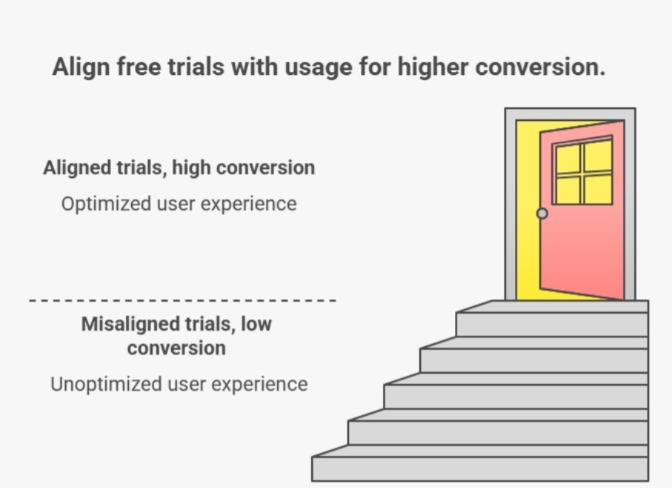
Trial optimization works best when driven by real behavior rather than assumptions or industry defaults. By analyzing Natural Usage Habits, segmenting users thoughtfully, and aligning trial experiences with actual usage patterns, teams can improve conversion without relying solely on longer trials.
At the same time, trial length is only one lever. Personalization, onboarding, and lifecycle communication can often unlock meaningful gains even when duration remains unchanged.
The goal is not simply to extend access, but to create a trial that is long enough for value to emerge and focused enough to remain sustainable.