App Market Research: The Complete Guide for Building Apps That Win
With more than 5 million apps competing across the App Store and Google Play, launching an app without proper market research is no longer risky; it is almost guaranteed failure. App market research separates apps that grow steadily from those that disappear silently. It helps you understand who your users are, what they actually want, how competitors are winning, and where real opportunities exist.
Whether you are validating a new app idea, planning your next feature release, or expanding into a new country, strong research reduces uncertainty and increases your chances of success. At ASOWin, we treat market research as the foundation of every growth decision. It is not a one-time task but a continuous discipline. This guide walks you through everything you need to know about app market research, from core concepts to advanced practices used by high-performing mobile teams.
Key Takeaways
- Market research is ongoing, not just pre-launch. Strong teams revisit research regularly to track competitors, user behavior, and category shifts.
- Every research effort should answer a real decision. It must clearly guide what to build, how to price, or which market to enter.
- Start wide, then go deep. Use existing data to understand the market, then validate with direct user insights.
- Size opportunities realistically using frameworks like TAM, SAM, and SOM.
- Validate demand early using keyword trends, store behavior, and user feedback.
- Understand users beyond age and income; motivation and behavior matter more than demographics.
- Use automation and AI carefully. Tools can scale insights, but human judgment is essential.
What Is App Market Research?
App market research is the structured process of collecting and analyzing data about your target market, competitors, and users to guide mobile app development and growth decisions. Unlike traditional product research, app market research focuses on mobile-specific factors such as app store discovery behavior, platform rules and limitations, mobile monetization models, short, context-driven usage patterns, and fast release and iteration cycles. The goal is simple: remove guesswork and replace assumptions with evidence. Good app market research helps answer questions like: Is there real demand for this app? Who are the strongest competitors and why do users choose them? What pricing or monetization model will work best? Which countries or user segments should we prioritize first?
Why App Market Research Is Critical
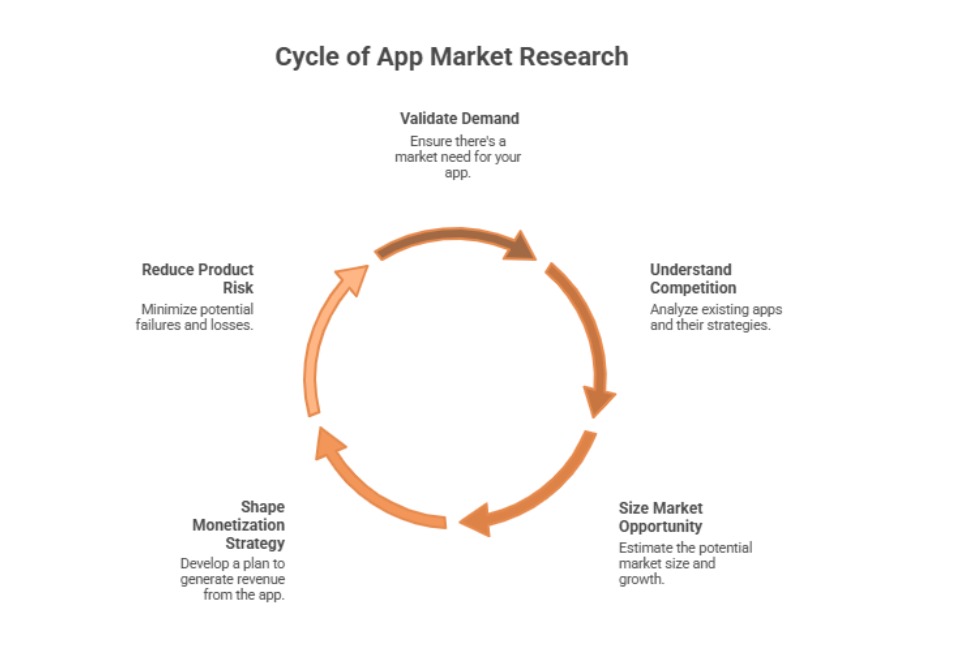
Validate Demand Before You Build
Research confirms whether users actually have the problem your app solves and whether they are actively looking for solutions. Keyword trends, competitor performance, and early user interviews prevent you from building in a vacuum.
Understand the Competitive Landscape
Studying competitors helps you identify feature gaps users complain about, monetization strategies that succeed or fail, messaging and positioning that drive installs, and opportunities to differentiate instead of copy.
Size the Market Opportunity
Market sizing helps set realistic expectations and priorities. Using the TAM-SAM-SOM framework allows teams to move from big ideas to achievable targets.
Shape Monetization Strategy
Different audiences respond differently to subscriptions, freemium models, or ads. Research shows what users are willing to pay for and what they expect for free.
Reduce Product Risk
Validating ideas early through surveys, interviews, and prototype testing saves time, money, and engineering effort later.
Types of App Market Research
Primary vs Secondary Research
Primary research involves collecting new data directly from users such as interviews, surveys, and usability tests. Secondary research uses existing data such as industry reports, store trends, and competitor analysis. The most effective approach combines both; understand the market broadly, then validate specifics with real users.
Qualitative vs Quantitative Research
Qualitative research explains why users behave a certain way, while quantitative research measures how many users behave that way. Both are essential. Numbers show patterns, conversations explain meaning.
Exploratory vs Evaluative Research
Exploratory research uncovers new opportunities and unmet needs. Evaluative research tests specific ideas, features, or pricing options. Strong teams move continuously between the two.
Attitudinal vs Behavioral Research
What users say they want often differs from what they do. Always validate opinions with real behavior such as usage data, retention, and conversion patterns.

How to Conduct App Market Research
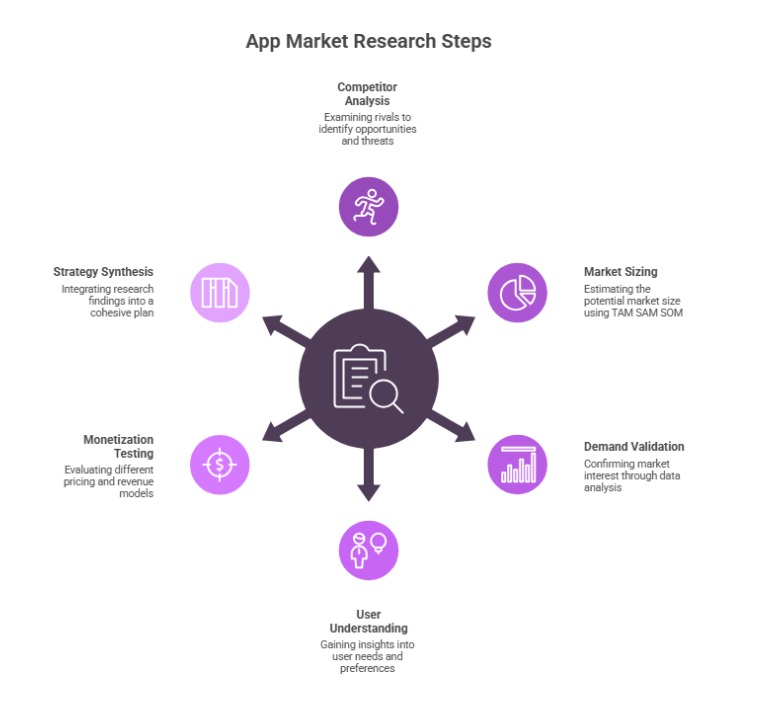
Step 1: Define Clear Research Objectives
Every research effort must link directly to a decision. Examples include: Which feature should we prioritize for retention? Is users' willingness to pay high enough to support subscriptions? Which market offers the fastest early traction? Define success thresholds in advance to guide go or no-go decisions.
Step 2: Analyze Competitors
Group competitors into direct competitors solving the same problem with similar solutions, indirect competitors solving the same problem differently, and aspirational competitors who define category benchmarks. Document their features, pricing, update frequency, ASO strategy, and review sentiment. Reviews often reveal the biggest opportunities for differentiation.
Step 3: Size the Market Using TAM SAM SOM
TAM includes everyone who could potentially use your app, SAM includes users you can realistically reach, and SOM is the share you can actually capture. Be conservative; early-stage apps typically capture a small fraction of their addressable market in the first year. Growth rate often matters more than size. A fast-growing niche can outperform a large but stagnant category.
Step 4: Validate Demand with Keyword and Store Data
Search behavior reveals real intent. Look for consistent search volume over time, rising trends rather than short-lived spikes, keywords with manageable competition, and apps ranking well with strong reviews. Map keywords to intent stages: problem discovery, solution comparison, brand and decision stage.
Step 5: Understand Your Users Deeply
Great apps are built on empathy. Go beyond demographics and explore motivations and pain points, habits and daily context, emotional triggers and expectations. Combine interviews, surveys, reviews, analytics, and social listening to build accurate user personas. At ASOWin, we often use jobs-to-be-done thinking to understand what users are actually hiring the app to do in their lives.
Step 6: Test Monetization and Pricing
Monetization should match perceived value. Common models include freemium with paid upgrades, subscriptions, one-time purchases, ads, or hybrid approaches. Pricing research methods include price sensitivity surveys, feature and price tradeoff tests, competitive benchmarking, and A/B testing post-launch. Pricing is not permanent; it should evolve with your product and audience maturity.
Step 7: Synthesize Insights into Strategy
Research only matters when it drives action. Create a clear summary covering market opportunity, key insights, recommended direction, risks and mitigation, and KPIs or success benchmarks. Translate findings into a feature roadmap, ASO and growth strategy, monetization plan, and market entry priorities.
Common App Market Research Mistakes
Relying only on reports without talking to users, treating iOS and Android as the same market, overestimating market share, focusing on features instead of outcomes, skipping pricing validation, and not updating research as markets evolve. Avoiding these mistakes saves months of wasted effort.
The Role of AI in App Market Research
AI helps teams analyze trends, reviews, and competitors at scale. It improves speed and pattern recognition, but it should always support human judgment, not replace it. The strongest strategies combine automation with real user understanding.
Final Thoughts: Turning Research into Growth
App market research is not about collecting data; it is about making better decisions with confidence. The most successful app teams continuously validate assumptions, stay close to user behavior, and adapt quickly to market changes. This mindset turns research into a competitive advantage. At ASOWin, we help teams transform market insight into ranking growth, higher conversion, and sustainable installs through strategic ASO and research-led execution. If you want to build, launch, or scale your app with clarity instead of guesswork, market research is where it all begins.